IRS Registered Tax Return Preparer Competency Exam Review


RTRP
Frequently Asked Questions

What is a Registered Tax Return Preparer and why should anyone in the tax return preparer field care?
On January 4, 2010, IRS Commissioner Shulman announced the results of a six-month study that included public hearings with consumer advocates, other government agencies, and tax professionals. This report was called the Return Preparer Review Final Report, and it called for a competency exam for tax preparers. This new process for tax preparers will require obtaining a Preparer Tax Identification Number, or PTIN, passing a one-time competency exam and passing a suitability check.
What work will someone who becomes a Registered Tax Return Preparer be able to perform?
Registered Tax Return Preparers may represent taxpayers before revenue agents, customer services representatives, or similar officers and employees of the IRS (including the Tax Advocate Service) during an examination if the Registered Tax Return Preparer signed the tax return or claim for refund for the taxable year or period under examination. This is consistent with the limited practice rights previously available to unenrolled return preparers. Registered Tax Return Preparers are not permitted to represent taxpayers regardless of the circumstances requiring representation before appeals officers, revenue officers, Counsel, or similar officers or employees of the IRS or the Treasury Department.
What would someone who passes the RTRP exam be called?
Registered Tax Return Preparers are permitted to use the term "designated as a Registered Tax Return Preparer by the Internal Revenue Service." In describing their designation, Registered Tax Return Preparers may not utilize the term "certified" or imply an employer/employee relationship with the IRS.
Can anyone get an exemption from the RTRP exam?
Yes, CPAs, EAs, and Attorneys are exempt. Also, preparers who do not prepare individual returns for compensation will not be required to complete the initial competency test or become a Registered Tax Return Preparer at this time. The IRS left open the door to requiring testing outside the 1040 universe in the future.
How would a preparer know if they could fall outside the scope of individual returns and Form 1040?
Non-Form 1040 series preparers are individuals who certify that they do not prepare, or assist in the preparation of any Form 1040 series tax return or claim for refund, except Form 1040-PR or Form 1040-SS, for compensation.

Non-Form 1040 series preparers may:
  1. Sign any tax return they prepare or assist in preparing;
  2. Represent taxpayers before revenue agents, customer service representatives, or similar officers and employees of the IRS (including the Taxpayer Advocate Service) during an examination if the individual signed the tax return or claim for refund for the taxable year under examination.
Must everyone who works on preparing a tax return be an RTRP, EA, CPA, or attorney?

No. Individuals who are not attorneys, certified public accountants, enrolled agents, enrolled retirement plan agents, enrolled actuaries, or Registered Tax Return Preparers will be eligible to obtain a PTIN and, thus, prepare, or assist in preparing, all or substantially all of a tax return or claim for refund for compensation in certain discrete circumstances. Section 1.02(1) of Notice 2011-6 permits certain individuals supervised by an attorney, certified public accountant, enrolled agent, enrolled retirement plan agent, or enrolled actuary who signs the return or claim for refund prepared by the individuals to obtain a PTIN. These individuals are required to certify in their application to receive a PTIN that they are supervised by an attorney, certified public accountant, enrolled agent, enrolled retirement plan agent, or enrolled actuary who signs the tax return or claim for refund and provide a supervising individual's PTIN or other number if prescribed by the IRS. These individuals may not sign any tax return they prepare or assist in preparing for compensation.

Individuals who do not sign, and are not required to sign, tax returns as a paid return preparer but are: employed by an attorney or CPA firm or employed by other recognized firms that are at least 80% owned by attorneys, CPAs, or EAs; and who are supervised by an attorney, CPA, EA, enrolled retirement plan agent, or enrolled actuary who signs the returns prepared by the supervised preparer as the paid tax return preparer may obtain a PTIN without taking the RTRP exam. They are also exempt from continuing education.

What is the process to become a Registered Tax Return Preparer?
Becoming a registered Tax Return Preparer is a three step process:
  1. Obtain a PTIN (and pay the amount provided in the PTIN User Fee regulations),
  2. Pass a compliance check and a suitability check, and
  3. Pass a one-time competency exam.

The process of becoming a Registered Tax Return Preparer is comparable to the existing process for enrolled agents. Their process is that individuals who obtain a provisional PTIN before April 19, 2012 may prepare for compensation any tax return or claim for refund until December 31, 2013, as long as the individual renews their PTIN, passes a compliance check and a suitability check, and pays the applicable user fee.

What is a compliance check?
The tax compliance check will be limited to an inquiry regarding whether the individual has filed all required individual or business tax returns (such as employment tax returns that might have been required to be filed by the applicant) and whether the individual has failed to pay, or make proper arrangements with the IRS for payment of any Federal tax debts.
What is a suitability check?
The suitability check will be limited to an inquiry regarding whether the individual has engaged in any conduct that would justify suspension or disbarment of any practitioner under the provisions of Circular 230, including whether the applicant has engaged in disreputable conduct.
Are there continuing education requirements?
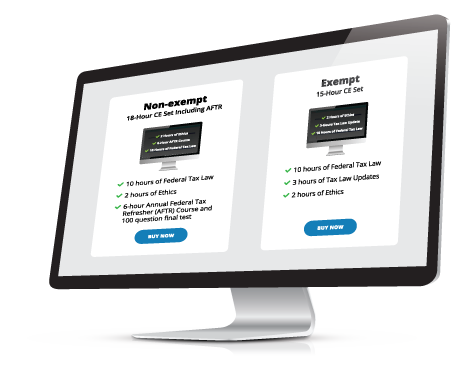
Yes, Registered Tax Return Preparers will also have continuing education requirements. Beginning in 2012, Registered Tax Return Preparers and individuals with provisional PTINs must complete 15 hours of continuing education during each registration year, with a minimum of:
  1. Three hours of Federal tax law updates,
  2. Two hours of ethics, and
  3. 10 hours of Federal tax law topics.

Registered Tax Return Preparers must maintain records with respect to completion of the continuing education credit hours and self-certify the completion of the continuing education credits at the time of renewal.

The regulations require that a qualifying continuing education course enhance professional knowledge in Federal taxation or Federal tax related matters and be consistent with the Code and effective tax administration.

Earn CPE Credit with RTRP Gleim Online: In addition to preparing you to succeed on the RTRP Exam, passing an End of Course Test in the Gleim Online course qualifies you to receive the 10 hours of CPE Credit for federal tax law topics required of all RTRPs annually.

Can an RTRP maintain their designation for their lifetime as long as they complete the necessary continuing education requirements?
Essentially, the answer is yes. However, a Registered Tax Return Preparer must annually renew their PTIN and pay a user fee. And, yes, they must continue their continuing education requirements of 15 credits of continuing education annually. Moreover, Registered Tax Return Preparers must retain records of continuing education courses.
I have more questions about RTRP. Where is a good source of additional information?
Dr. Hasselback has a very informative blog devoted to anyone interested in obtaining an RTRP designation. Visit the RTRPBlog.com.