|
 |
|
Requirements to Obtain an Instrument Rating
|
|
|
|
 |
- Hold at least a private pilot certificate.
- Be able to read, write, and converse fluently in English.
-
Hold a current FAA medical certificate.
-
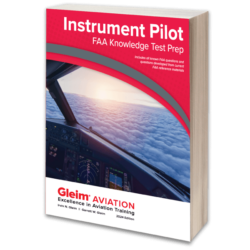
Receive and log ground training from an authorized instructor or complete a
home-study course, such as using
Instrument Pilot FAA Knowledge Test
(and the related Gleim
FAA Test Prep
CD-Rom), and
Pilot Handbook. Subjects include:
- FARs
- IFR-related items in the AIM
- ATC system and procedures
- IFR navigation
- Use of IFR charts
- Aviation weather
- Operating under IFR
- Recognition of critical weather
- Aeronautical Decision Making (ADM)
- Crew Resource Management (CRM)
- Pass the FAA instrument rating knowledge test with a score of 70% or better.
-
Accumulate flight experience (FAR 61.65):
-
50 hr. of cross-country flight time as pilot in command, of which at least 10
hr. must be in airplanes:
-
The 50 hr. includes solo cross-country time as a student pilot, which
is logged as pilot-in-command time.
-
Each cross-country must have a landing at an airport that was at least
a straight-line distance of more than 50 NM from the original departure
point.
-
A total of 40 hr. of actual or simulated instrument time in the areas of
operation listed in 7. below, including:
-
15 hr. of instrument flight training from a CFII (CFII is an instructor
who is authorized to give instrument instruction) days preceding the
practical test
-
Cross-country flight procedures that include at least one cross-country
flight in an airplane that is performed under IFR and consists of:
-
A distance of at least 250 NM along airways or ATC-directed routing
- An instrument approach at each airport
-
Three different kinds of approaches with the use of navigation systems
-
If the instrument training was provided by a CFII, a maximum of 20hr. may be
accomplished in an approved flight simulator or flight training device.
-
Use our
Instrument Pilot Flight Maneuvers and Practical Test Prep
book from your first flight lesson to your practical test. We outline and
illustrate each flight maneuver you will perform during your flight training
and explain the common errors associated with each flight maneuver.
-
Demonstrate flight proficiency (FAR 61.65). You must receive and log training, as
well as obtain a logbook sign-off (endorsement) from your CFII on the following
areas of operation:
- Preflight preparation
- Preflight procedures
- Air traffic control clearances and procedures
- Flight by reference to instruments
- Navigation systems
- Instrument approach procedures
- Emergency operations
- Postflight procedures
-
Successfully complete the instrument rating practical test, which will be conducted
as specified in Gleim's
Instrument Pilot Flight Maneuvers and Practical Test Prep.
|
|
|