Contact Us : 800.874.5346        International: +1 352.375.0772


Where can I find free CMA exam questions?

Right here! You’ll get access to CMA exam questions for Part 1 and Part 2 when you sign up for a free account.

Our free questions are not simply a random test bank—they’ve been selected by our editors to follow the topic weighting of the CMA exam and are representative of the kinds of questions you may actually see on your CMA exam. Just like in our courses, every question comes with explanations for the right and wrong answer choices. When you’re done, you’ll get a score breakdown by topic area.

Select an exam part below to get started. 

Part 1

Financial Planning, Performance, and Analytics

Part 2

Strategic Financial Management

Our question library contains some retired exam questions released by the ICMA. Not all of the questions you receive will be retired questions.

Overview of the CMA exam questions

The Certified Management Accountant (CMA®) exam is comprehensive and robust, and will challenge your understanding of the material and test-taking skills. There are two types of questions you’ll receive on the CMA exam:

Each of the two CMA exam parts consists of 100 multiple-choice questions and two case-based questions. You must answer 50% of the MCQs correctly in order to progress to the CBQs. You’ll have 4 hours to complete an entire exam part (3 hours for MCQs and 1 hour for CBQs). If you finish your MCQs early, you’re allowed to carry over any time remaining to the CBQs.

Exam Format MCQs CBQs
Number of Questions  100 2
Time Allotted 3 hours 1 hour

When you’re considering CMA exam questions and what could be thrown at you on the day of the test, knowing the tips, tricks, and best practices becomes essential. Keep reading to get all the information you need to prepare yourself for any and all CMA exam questions.

CMA exam multiple-choice questions

The first obstacle you’re going to face on the CMA exam is the multiple-choice section. Knowing how to answer multiple-choice questions is key to passing the CMA exam, so we’ve provided you with all the information, examples, and advice you need to prepare for them.

Multiple-choice question format

To start, it’s important to understand the anatomy of a multiple-choice question so that you know what to pay attention to on exam day. 

Question

This includes the question you need to answer and any supporting information. Some of that information will help you find the answer, while some may be there to distract you.

Correct answer choice

Out of the four answer choices provided, you’re looking for one correct answer. Even if more than one option seems plausible, only one choice best answers the question.

Incorrect answer choices

Some answer choices may seem correct at first glance or reflect common calculation errors. These incorrect options, often called distractors, are designed to pull you away from the best answer.

There are different types of MCQs. Most CMA exam multiple-choice questions just feature four single-statement answer choices and look like the example shown here. 

Some MCQs have a negative stem, which means that the question stem contains words like except, not, false, least, etc. Some examples of negative stem MCQs can be found below. The ICMA will most likely print the negative words in bold, but you should always read the question carefully and completely.

Answering these questions will be counterintuitive because your goal will be to select the wrong answer choice, and the remaining answer choices will all be correct. Giving the question stem all of your attention will help you detect when the exam’s expectations have switched in this way.
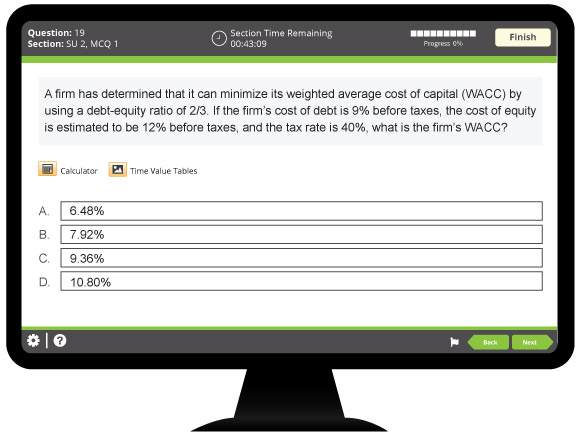
Standard CMA exam question for CMA exam tips

Which of the following is not a method of financing international trade?

All of the following statements in regard to working capital are true except…

CMA exam case-based questions

As a CMA candidate, you will need to be able to demonstrate your ability to apply your knowledge to real-world scenarios. Among the on-the-job skills for CMAs is the ability to evaluate the data available and make a strategic recommendation or decision. Don’t worry, though; we’ve covered everything you need to know about the CBQ portion of the CMA exam.

The CMA exam uses case-based questions to test your ability to:

  • Evaluate a given set of data
  • Make a judgment when given alternative solutions
  • Justify a selected course of action

Case-based questions allow you to demonstrate these abilities and skills in a situation that more closely reflects the real world than multiple-choice questions can. CMAs are relied on to provide analyses and recommendations based on the numbers, and fulfilling these responsibilities requires strong analytical skills.

Case-based question format

There are two CBQ scenarios for each exam part. Each CBQ contains an approximately 250-word case study and up to seven questions that come in a variety of types.

Many of the CBQ question formats are more interactive than a standard MCQ, and you may need to drag and drop answer options, enter a number into a box, or select from drop-down lists. 
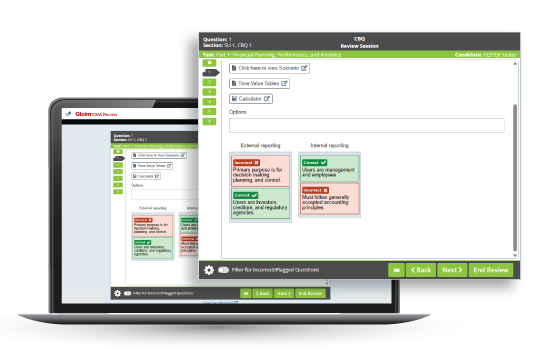
CMA case-based question on a laptop screen.

CBQ question types

Drag and drop

Drag correct answers to the corresponding option.

Select from a list

Select an option from a drop-down box.

Numerical response

Type a numerical answer into a box.

Multiple response

Select more than one correct answer to the question.

Multiple choice

Select one correct answer out of four options.

The following graphic is an example of how the case-based questions will look on the day of your test. Keep reading and cross-reference the numbers on the page with their description below. 
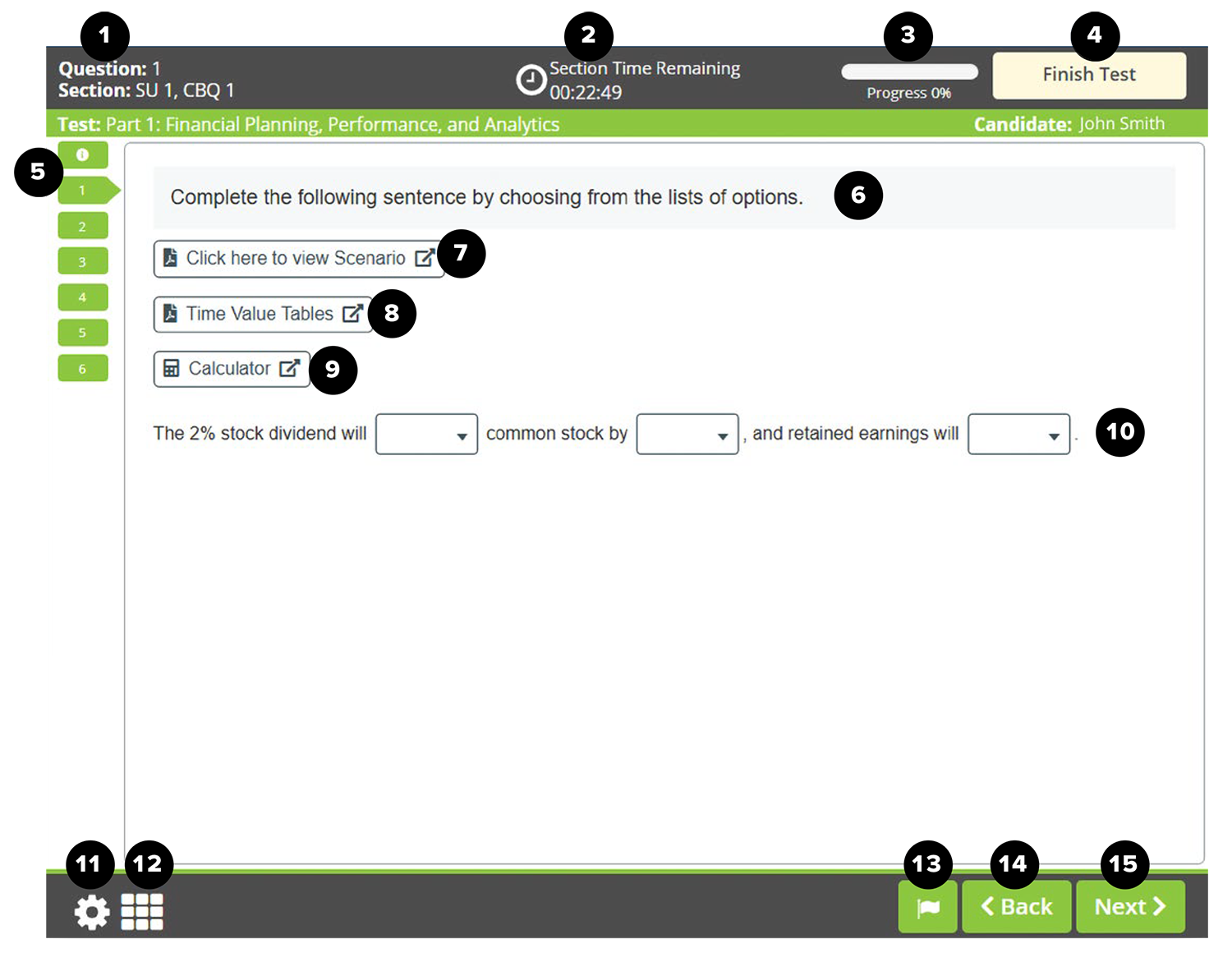
Case-based question screen description

1. Question Number and Section
Indicates which question you are answering and the section of the exam you currently have on screen.

2. Time Remaining
Displays the time you have remaining in the current section. Clicking it will display the total exam time remaining.

3. Progress
Tracks the percentage of questions complete in the current section.

4. Finish
Don’t click this button until you have responded to or flagged all of the CBQs. Clicking it will take
you to a review showing questions unanswered or flagged, and from there you can move on to the voluntary survey section of the exam.

5. Navigation Menu
A visual representation of where you are on the current section of the exam. You may use this menu to quickly move between questions. The numbered buttons change appearance according to their status (see below for more details).

6. Question
Displays the content of the current question.

7. CBQ Scenario
Displays a new screen with all of the information you will need to answer the questions. It will
open as a PDF.

8. Time Value Tables
This gives you access to Time Value Tables for questions that require them. It will open as a PDF.

9. Calculator
A basic tool for simple computations. It is similar to calculators used in common software programs.

10. Answer Options
Where you select the correct answer(s) out of the option(s) provided.

11. Preferences
The gear icon leads to a preference menu filled with options for adjusting the text and background colors of the exam screens. If you experience discomfort or difficulty reading the
exam screens due to the default color scheme, this menu is helpful for finding a more visually
accessible palette.

12. Section Review
The grid icon opens a menu where you can review your unattempted, attempted, and flagged questions.

13. Flag
Mark a question for later review.

14. Back
Move to the previous question.

15. Next
Move to the following question.

CBQ navigation menu buttons

As you’re taking the test, you will also run into navigation buttons. These buttons exist to help you navigate through the test—it’s helpful to know how they work and what they look like.

Current: This button is green and arrow-shaped, and indicates the question you’re currently viewing. It becomes gray once you select an answer choice.

Complete: A dark gray rectangle indicates that you have selected an answer.

Incomplete: A green rectangle indicates that you have not selected an answer. It becomes arrow-shaped when it is the question you are currently viewing.

Flagged: A green rectangle with a flag icon next to the question number indicates this is a question you have not answered, and have marked for review.

How to answer CMA exam questions

You don’t just need to know the CMA exam content—you need to be able to answer MCQs and CBQs effectively and efficiently. That’s why it’s important to get plenty of practice answering questions and go into the exam with a strategy. 

Use a time management system

As a reminder, the total testing time allocated for each of the two CMA exam parts is 4 hours. You have 3 hours to answer all 100 MCQs. Spending the entire 3 hours answering the MCQs gives you a maximum of 1 hour total to finish the CBQs. When you finish the MCQ section in less than 3 hours, your remaining time from the MCQs will carry over and extend the one-hour time allocation for the CBQs.

We recommend that you aim to answer each MCQ in 90 seconds to give yourself either 30 extra minutes to review your MCQ answers or to respond to the CBQs. You can also divide this time between the two activities however you see fit. 

The ideal way to break down your time is:

  • MCQs: 2 hours and 30 minutes
  • Review: 15 minutes
  • CBQs: 1 hour and 15 minutes

Keep in mind, you cannot return to the MCQ section once you’ve entered the CBQ section, so you’ll need to complete your review of your MCQ answers before you move on to the next section.

Question answering tips

Learn how to avoid common mistakes on multiple-choice and case-based questions and what to expect on exam day. Use our tips to help maximize your CMA exam score.

Multiple-choice question answering tips

Work through the MCQ parts systematically
Start the process of answering by reading the actual question, which is usually the last sentence of the stem. Use the question to determine what amount of information in the stem is important and what is non-essential. Write down the important information so it is easier to separate it from everything else in the stem.

Apply your exam time-management strategy when you answer practice MCQs
If you allot 1.5 minutes per question to complete all 100 MCQs on each exam part, you’ll have 30 minutes that you can either spend reviewing your MCQ answers or carry over into the case-based question portion of the exam. On the exam, you should use as much of this time to review as you need and then move on to the CBQs. During your study sessions, you should practice answering each MCQ in 1.5 minutes.

Learn from your mistakes
You need to answer a lot of practice questions to prepare for the 200 total multiple-choice questions on the CMA exam, and each question you get wrong gives you the opportunity to avoid making the same mistake when it counts. You learn more from your mistakes than you do from getting everything right, so you should review answer explanations as you complete practice questions. Whether you answered correctly or incorrectly, review the answer explanations for all of the answers. The detailed answer explanations included in Gleim CMA Review will help you understand why the original answer you chose is wrong and why the correct answer indicated is right.

Focus on what the question is asking
Read the question stem first, then go back and read the rest of the information provided to pull out what is needed. Don’t focus on all of the data that a question may provide until after you have determined what the actual question is. This will help you filter out misleading information and save you valuable test-taking time.

Be on the lookout for questions that ask for an exception. These questions will usually use words such as not, except, false, least, etc. These words will usually be bold on the CMA exam, but do not assume they all will be.

Predict the answer
Right after you’ve read the question, your mind will be the most focused. Make a prediction about what the right answer should be before you read the answer choices. Once you have an answer in mind, scan the answer options to see if your answer is present. Even if your predicted answer is present, it’s a good idea to read the other options to ensure none of them are better.

Read all of the answer choices carefully
Sometimes a question will have multiple answers that could be argued to be correct. Remember, you’re always looking for the answer choice that best answers the question.

In addition, sometimes reading the answer choices can clue you into what the question is asking. If all of the answer choices seem wrong based on your understanding of the question, you should probably reread the question to make sure you’re not missing something.

Watch for qualifying words like “always” or “never.” These words leave no room for exceptions and can often make an otherwise good answer incorrect because exceptions usually exist.

Answer every question on your first pass
You don’t lose points for answering questions wrong on the CMA exam, so never leave any question blank. Even if you don’t know the answer, select one of the possible answers. This will at least give you a 25% chance of answering correctly, and if you’re able to first eliminate two answer choices through educated guessing, you can increase your odds to 50%.

If you don’t know the answer, use your educated guessing skills and mark the question to review later. If you have time remaining in your 3 hours, you can go back and review questions you’ve marked to see whether you’re able to determine the answer. If you still aren’t sure, stick with your first choice and don’t spend a lot of time worrying about it.

Don’t be afraid of making an educated guess
The CMA exam covers a large amount of information, and even a well-prepared CMA candidate is likely to encounter some questions they don’t know the answer to. In these cases, an educated guess can make all the difference.

Follow these steps to improve your educated guessing technique:

  • Rule out answers you think are incorrect right away. Many questions, including calculation questions, will have one or two answers that are easy to eliminate if you’re familiar with the material.
  • Ask yourself whether one of the remaining answers more completely addresses the question than the others. You can usually narrow it down to two choices. Pick the best one of the two.
  • Once you’ve narrowed your options down, trust your instincts. Unless you realize you read the question incorrectly or made a calculation error, your gut is usually correct. Talking yourself out of a correct answer is a common reason for selecting the wrong answer, so select the one that makes the most sense and move on. Use that time you would have spent deliberating where it can make a difference.

Case-based question answering tips

 Skim the CBQ scenario before you read the questions.
By skimming the scenario, you’ll have context to help you understand the questions. Then you can read the questions to determine which areas of the scenario need your focus (this will help you avoid extraneous information).

Read the requirements for each question carefully.
Focusing on the question requirements will allow you to easily identify the most relevant information in the scenario.

 Answer the easiest questions first.
Within any CBQ scenario, some questions will be easier than others. Getting a few easy questions solved before you tackle a tougher one can help you build your confidence.

 Answer every question.
Do not agonize over any one question or scenario. You will be able to return to questions previously answered and move between scenarios as time permits. If needed, you can always flag questions and go back and add something or check your work if you have extra time.

 Follow a time management system.
Time is valuable, and you’ll need the entire hour to answer all of the questions in each CBQ. The number of questions per scenario will vary, as well as how much total time you have to spend (based on when you completed your multiple-choice section). You will have 60 minutes in total, so practice allocating 30 minutes per scenario and then dividing that time evenly between questions.

How are CMA exam questions graded?

On both the MCQs and CBQs, you earn points for each correct answer, and you won’t lose points for incorrect ones, so never leave an item blank. On the CBQs, you can earn partial credit. For example, if a multiple-response question asks for three answers and you get two correct, you will receive partial credit. 

Your exam will not be graded instantly because CBQs are graded offline by subject matter experts. Your total MCQ score will be added to your CBQ score to get your total weighted score. 

Learn more in our guide to CMA exam scores and pass rates.

Frequently Asked Questions
About CMA Exam Questions

What types of questions are tested on the CMA exam?

The CMA exam tests you with 100 multiple-choice questions (MCQs) and two case-based questions (CBQs). 

Are case-based questions harder than multiple-choice questions?

Many candidates will find the case-based questions more difficult than MCQs because they test your ability to take your knowledge of the concepts and apply it to real-world scenarios. 

How can I practice answering CMA exam questions?

We provide free CMA exam practice questions for both Part 1 and Part 2. Sign up or log into your Gleim account to try these questions. When you’re ready to start studying, choose our CMA Review Course to get thousands of practice questions. 

How much time do I have to answer the questions on the CMA exam?

On CMA exam day, you’ll have 4 hours to complete the exam. There are 3 hours for the multiple-choice questions and 1 hour for the case-based questions. If you finish your MCQs early, you’re allowed to carry over any time remaining to the CBQs.

Ready to start studying?
Choose your course and join the millions who passed with Gleim!